
Build Log: Architecting Cypher — The Auxiliary Brain We're Building for Ourselves First
Pyris Build Log Entry: A look behind the curtain at Cypher — the institutional-memory system we're building, why it surfaces patterns instead of making decisions, and the node-map that came out of it.
Most of what we publish here is educational — how to scale operations, how to implement AI without joining the failure pile, how to keep your systems from drifting. This is different. This is a build log: an honest look at what we’re actually building in the workshop, why, and what we’re learning. We build serious systems for our clients, and we build them for ourselves first. This is one of the ones we’re building for ourselves.
What if your business had a working memory?
Every company has a memory problem it’s learned to live with. Not a data problem — companies are drowning in data. A memory problem. The data is all there, sitting in the Slack threads and the docs and the recorded calls and the dead Notion pages. What’s gone is the why. Why we killed that product line. What the person who left actually knew. Which objection really keeps killing deals — not the tidy one in the CRM dropdown, the real one, worded forty different ways across forty lost-deal notes.
The company experienced all of it. It just can’t remember it, because the memory walked out with the people, and every tool built to fix this throws away the only part that mattered — the reasoning, the dead ends, the verbatim record of how the call actually got made.
I’ve been chewing on this problem for a while, and we’re building something for it. We call it Cypher.
Fair warning before I go further: this is a big idea on a piece of paper that’s becoming a real thing slowly. I’m not going to oversell it. It’s early. But the architecture is live in a working deployment, the thing does what it’s supposed to do, and it produced a visual I think is genuinely cool — so I want to show you the shape of it.
What’s in this one:
- The Problem Nobody Prices Correctly
- What Cypher Is (Four Ideas That Don’t Usually Sit Together)
- The Part That’s Actually New: Roaming Intelligence
- The Wall: It Surfaces, It Never Rules
- The Node Map
- Why We’re Building Our Own First
The Problem Nobody Prices Correctly
Companies pay to solve this all the time — they just don’t recognize it as one problem. They buy a knowledge base, which retrieves documents but doesn’t hold judgment; it gives you the sanitized retro, not the argument that produced it. You get the what, but not the why. They hire a strategy consultant, who finds the cross-silo insight nobody inside could see — brilliant, expensive, and gone in ninety days, taking all the context with them. So eighteen months later they hire a different firm to rediscover what the last one found.
The single most expensive thing a company owns is the accumulated reasoning of everyone who ever worked there. And it evaporates a little more with every departure, every reorg, every “wait, why did we decide that again?” Nobody puts a line item on it because it doesn’t show up missing until you need it.
That’s the problem Cypher is built around.
What Cypher Is (Four Ideas That Don’t Usually Sit Together)
Cypher is an institutional auxiliary brain. Four layers, and the interesting part is that they don’t normally appear in the same system:
The Floor — an immutable, verbatim record of how the company actually reasoned. Decisions, debates, the dead ends and the failures held at the same resolution as the wins. Not summarized. Not cleaned into a highlight reel. The actual record, held permanently and read by pointer, never reworded. Most systems put their intelligence in storage — better search, smarter index. Cypher leaves storage deliberately dumb and puts the intelligence in the reading. The floor is a vault; the genius — I think, anyway — is in how it gets recalled and recombined.
The Read — ask it anything about the company’s own history — what did we decide about X, why, who pushed back — and it reads the full record into a true, sourced answer. Not a search result. A comprehended account of what actually happened, with receipts.
The Roam — the part no one else has. More on that below; it’s the core.
The Filter — a role-aware layer that learns, from feedback, what this company’s people actually need surfaced, and to whom. It becomes the company’s taste for its own blind spots, sharpening every week.
Vault, librarian, consultant, chief of staff. One brain.
The Part That’s Actually New: Roaming Intelligence
Here’s the piece I’m most interested in, because I haven’t seen anyone else build it.
Every retrieval tool on the market is bounded by the query. You can only ever find what you thought to ask. Search answers questions — it cannot find them. Cypher’s roaming layer is bounded by nothing. Its entire job is to wander the full corpus (the full written record, “The Floor” above) with no query and no target, looking for the thing nobody asked about: the cross-domain rhyme. The churn pattern in the support tickets that rhymes with the objection the lost deals keep hitting that rhymes with the risk an engineer flagged in a doc no one read.
No single person in a company can see that, structurally — because every person lives in one silo. Support sees support. Sales sees sales. Cypher sees the shape across all of them and surfaces it: these three things you’re treating as separate problems are one problem — did you notice?
That’s the deliverable companies pay consultants millions for, once. Cypher does it continuously, on the full record, and it never leaves.
The Wall: It Surfaces, It Never Rules
This is the part I care about most, and it’s not a feature we bolted on for safety — it’s the conviction the whole thing was built around.
Cypher does not decide. It doesn’t approve, it doesn’t recommend-as-truth, it doesn’t take accountability for a call. It brings the pattern to the human who owns the decision and it stops there. The human decides. Always.
That’s not a limitation. It’s the entire reason a system like this is safe to let into a business. There’s no accountable machine in the loop, no liability transfer, no automated judgment you’d have to audit. An advisor that never takes the wheel. The org’s accountability stays exactly where it legally and culturally has to.
Most of the industry is racing the other direction, toward AI that decides, because deciding demos better. I think they’re all building toward a wall they’ll eventually hit. We started on the other side of it.
The Node Map
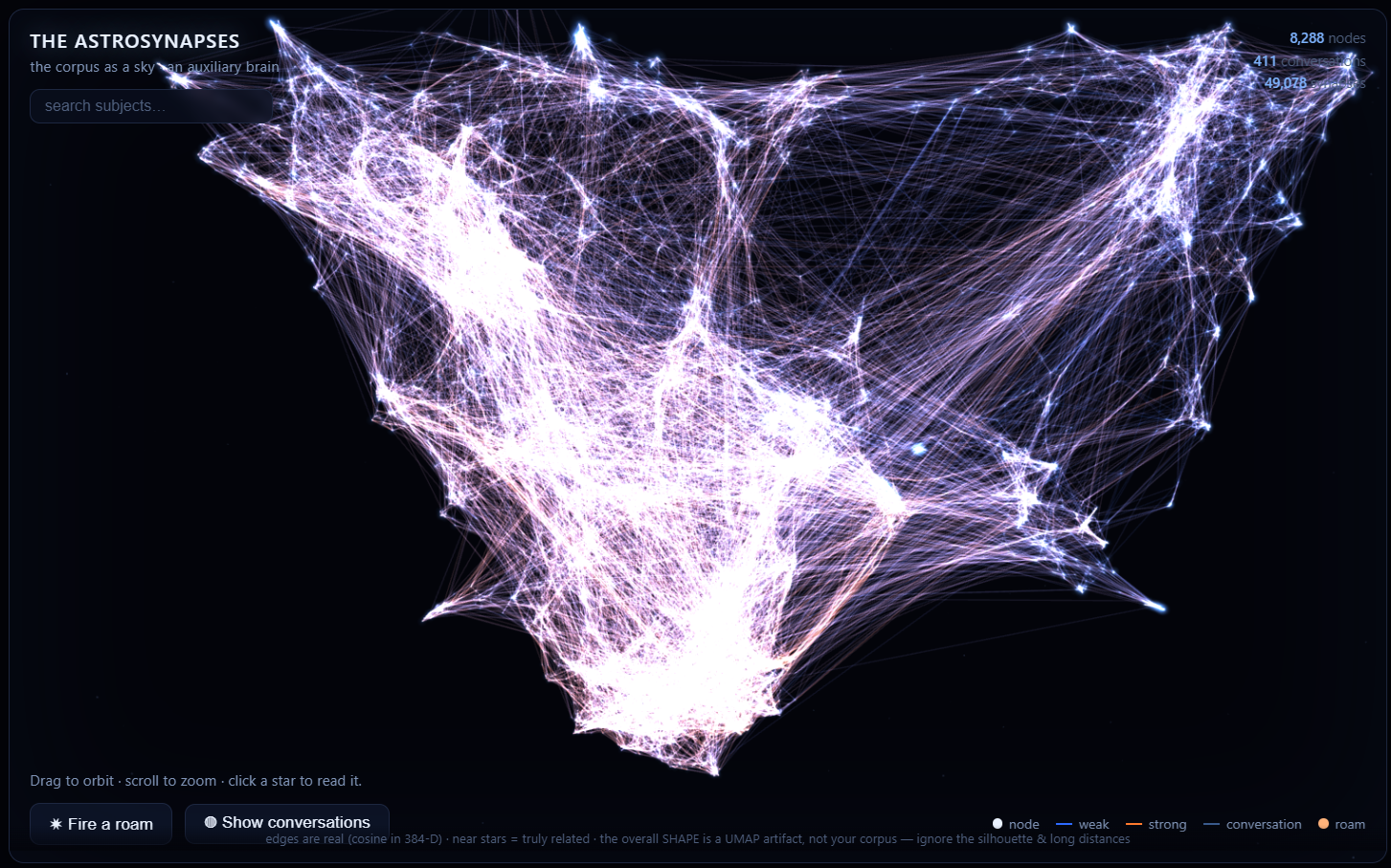
Here’s the thing I actually wanted to show you. As part of building the comprehension layer, we built a tool that maps the corpus — every node a piece of reasoning, every edge a connection the system found between them. We call it AstroSynapses. This is what the institutional memory looks like when you render it:
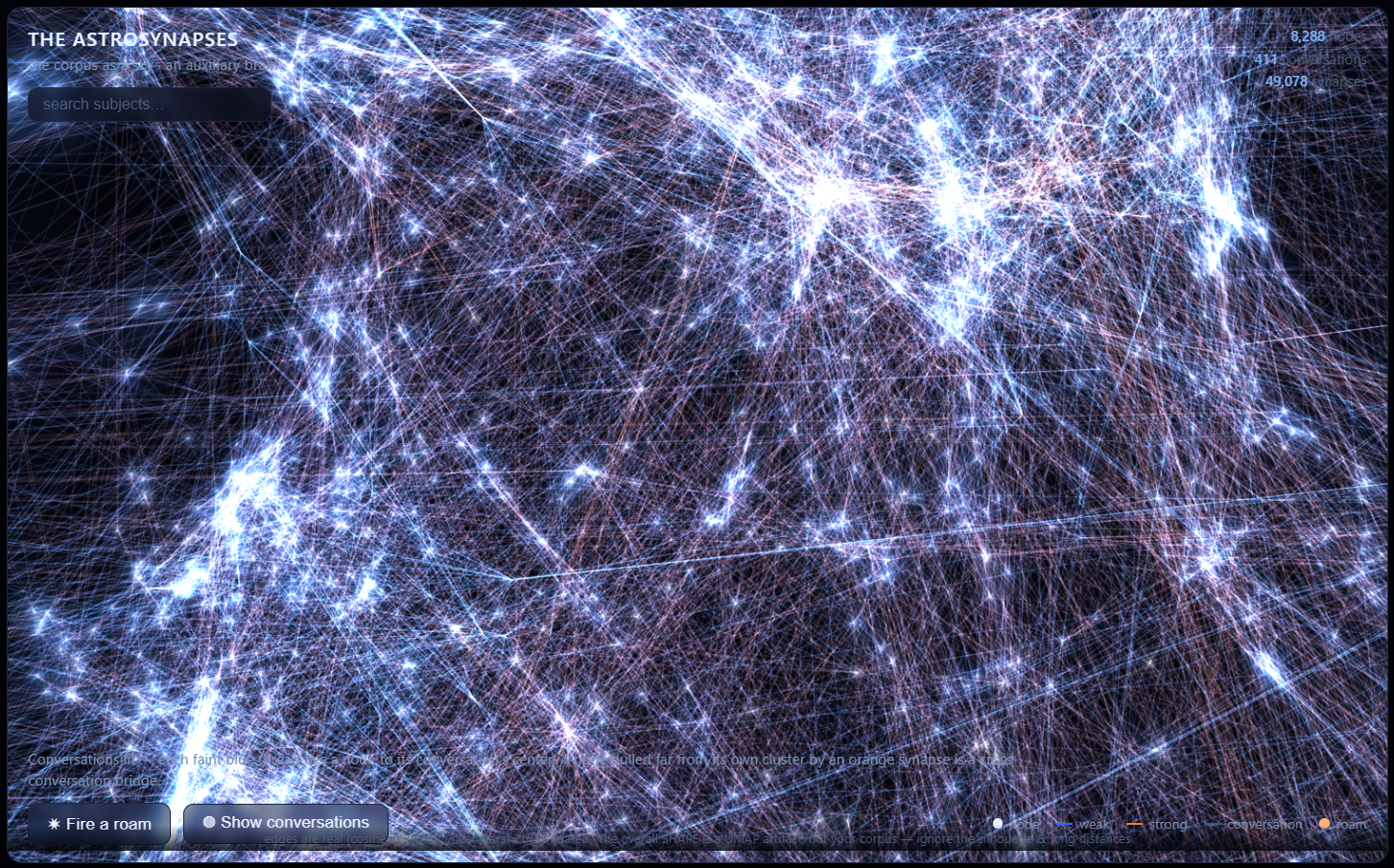
Above: AstroSynapses, the corpus Cypher reads, rendered whole — 8,288 nodes, 49,078 synapses, every line a real connection (cosine similarity in 384 dimensions) the system found between two pieces of reasoning. The overall silhouette is a projection artifact, not a real shape — but the local structure, the clusters and the bridges between them, is genuine. This is what “remembering the why” looks like when you can finally see it.
I’m not going to pretend the picture is the product — it’s a visualization, and a visualization is not a deliverable. But it’s a real render of a real corpus in a real deployment, and it maps something companies have never been able to see: the actual shape of their own accumulated reasoning, with the cross-silo connections drawn in. The first time it rendered, it was hard not to stare at it. (And in the spirit of not overselling: that brain-like outline is partly an artifact of squashing 384 dimensions down to two for your screen — the honest version is in the fine print on the render itself. The connections are real; the silhouette is the projection’s editorializing.) But — I needed to see what the connections looked like. I got tired of staring at numbers and counts. So… here’s what it looks like.
Why We’re Building Our Own First
We build systems for clients. We also build them for ourselves — and we build ours first, on purpose, because we refuse to sell a thing we haven’t run in our own shop under real conditions. Cypher is the institutional memory we wanted: something that holds the reasoning behind everything we’ve built, catches the patterns across our own work that no single project window can see, and makes sure our own agents never drift onto a stale instruction. We’re our own first hard test case.
Where it goes from here — whether the single-subject version becomes the org-scale version, on what timeline — is genuinely still being figured out. It’s a big idea on paper that’s earning its way into being real one proven layer at a time. It’s one of those projects whose architecture has to be torn apart and put back together repeatedly at every step, because it’s new ground. That’s the honest status, and I’d rather give you the honest status than the pitch.
But that’s the workshop right now. That’s what we’re building. And if you want the people building this to build yours —
Let’s talk. 20 minutes, no pitch deck. Bring us the chaos; we like the hard ones.
Jake Botticello is the founder of Pyris Consulting. This is the latest entry in the Pyris build log — an ongoing, honest look at what we’re building in the workshop. More to come, every time we ship something worth showing.
Frequently Asked Questions
What is an institutional memory system?
An institutional memory system is software that preserves why a company made its decisions — the reasoning, debates, and dead ends — not just the documents and data it produced. Most companies don't have a data problem; they have a memory problem. The data is all in the Slack threads and recorded calls. What's missing is the why, and the why walks out the door with the people who leave.
What happens to company knowledge when employees leave?
Most of it is lost. The single most expensive thing a company owns is the accumulated reasoning of everyone who ever worked there — why you killed that product line, what the person who left actually knew, which objection kept coming up in sales three years ago — and it's systematically, structurally thrown away. Knowledge management tools store the what. They almost never capture the why, which is the part that's actually expensive to lose.
What's the difference between knowledge management and institutional memory?
Knowledge management stores the what — the finished document, the filed record, the search result. Institutional memory preserves the why — the reasoning behind the decision, who pushed back, what you were afraid of. A knowledge base can tell you what you decided. It usually can't tell you why, and the why is what you actually need when you're about to make the same call again.
Can AI find patterns a human can't see in a business?
Yes — because no single person in a company can see across every silo, but a system reading the entire corpus can. Every human lives in one silo; no one reads everything, knows everything, and sees across all of it at once. A roaming AI layer whose only job is to wander the full history looking for connections can surface the thing nobody thought to ask about: these three problems you're treating as separate are actually one problem — did you notice? That's the cross-silo insight companies pay strategy consultants millions for, once.
Should AI make decisions for your business?
No. AI should surface patterns to the humans who decide, and stop there — it should never approve, rule, or take accountability for a call. That's not a safety feature bolted on afterward; it's the entire reason a system like this is safe to let into a business. An advisor that never takes the wheel. The org's accountability stays exactly where it legally and culturally has to. Most of the industry is racing the other way, toward AI that decides, because deciding demos better. We're going the other direction on purpose.
What is Cypher by Pyris Consulting?
Cypher is an institutional auxiliary brain built by Pyris Consulting — a system that preserves a company's reasoning verbatim, answers questions about its own history with citations, roams the full corpus to surface patterns nobody queried for, and learns what each role needs surfaced. Vault, librarian, consultant, and chief of staff in one brain. It's early and honest about being early, but the architecture is live and the node-map is a real render of a real corpus: 8,288 nodes and 49,078 connections.
Why should a consultancy build its own tools before selling them?
Because being your own first hard test case is the most honest way to know a system works. We build serious systems for clients, and we build them for ourselves first, on purpose — Cypher holds the reasoning behind everything we've built and flags when one of our own agents is about to drift onto a stale instruction. If we won't run it on our own business, we have no business selling it to yours.